
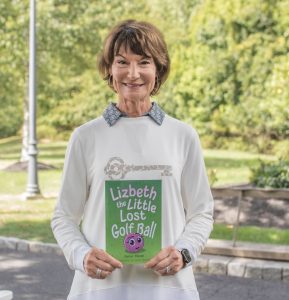
When Janice Nissen retired from her biopharmaceutical career in 2022, like many retirees, she searched for a new outlet to channel her energy and enthusiasm for life. So, like millions of others, she turned to golf, a sport that allowed her to be outside and enjoy nature, as well as provide her with an avenue for self-mastery and log over seven miles of steps with each round.
It was during her time on the greens, where she had her share of frustrations, that the idea for Lizbeth, the Little Lost Golf Ball, came to life. “I happened to have lost a golf ball in a water hazard and went to look for it,” says Janice. “I didn’t find my ball, but found another one. And I thought to myself as I picked it up, I wonder what this little ball has gone through and what sort of little adventures it has had.”
Her pondering didn’t stop there. Janice continued to reminisce about her experiences on the greens, including divers rescuing lost golf balls from ponds, alligators climbing out of the water and onto the greens, scaring golfers in doing so, and the many pieces of equipment golfers possess.
As a grandparent, she also hoped to one day share her love of golf with her toddler-aged grandchildren, and knowing the power of storytelling, she questioned, “How do we turn this world of golf all into a story that could actually help children learn about the game in a really fun and whimsical way?”
And that’s how Lizbeth, the Little Lost Golf Ball was conceived.
The story revolves around Lizbeth, a brand-new, hot pink golf ball, purchased by a junior golfer, JoJo, and the two set out to play. Along the way, Lizbeth meets several other characters, including Delilah Driver, Frida Flag, Fairway Freddy, Rachel Rake, Putter Pete, and Claude Cup –all of whom eagerly teach Lizbeth about the game of golf by answering her many questions, such as “What’s a fairway? What’s a green? What does par mean? What’s a birdie?”
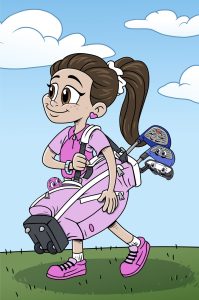
Illustrated by James Koenig, a prolific illustrator from Gilbert, Arizona, the key themes in the book include embracing adventure and curiosity and maintaining a positive mindset. JoJo, the junior golfer, is also a key player in the story. “She’s a very dedicated golfer and loves everything about the game. She demonstrates the importance of patience, persistence, and practice,” explains Janice.
Like many in the sport, Janice believes that golf is a game of self-improvement. “When we play the game, we’re competing with ourselves! Any improvement we experience will spill over into other areas of our lives.”
The story also highlights the message of maintaining hope when life gets tough. JoJo also has a moment where her game doesn’t go as planned, and Lizbeth lands in a pond, where she meets Teddy, a lost golf ball who actually prefers life in the pond, and his friend Genji Gator. Ultimately, through their support, Lizbeth regains her optimism and returns to JoJo and to her friends on the greens, a little wiser and happier. 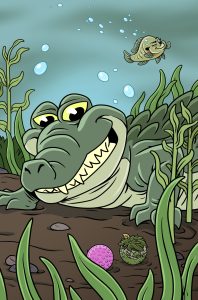
“Let’s face it, and I can attest to this, golf can be a very frustrating game. But with children, we really want to make sure that they have the right expectations. It’s not a magical thing where they’re going to go out and swing a club and then get a hole in one, right?”
Cherishing friendships is also highlighted, stemming from the relationships Janice formed and strengthened on the greens. “It’s essential for children to see the support and guidance that can be derived from different relationships, even challenging ones,” says Janice,who is also a patient engagement consultant to the Foundation for the NIH. “For instance, early in the story, Lizbeth meets Bully Ball, a lost golf ball with a rather rigid, sour outlook on life. He actually believes all golf balls should be white. But later in the story, he was one of the characters who softened and supported Lizbeth in reuniting with JoJo.”
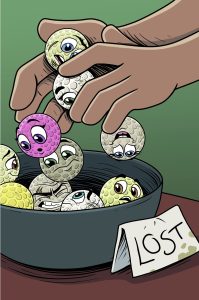
Perhaps most importantly, Lizbeth and JoJo also inspire children to step away from their screens and onto the greens. “Playing golf allows us to experience the outdoors and connect with nature, and that is often missing in our busy lives with school and work,” says Janice, who will be spending more time on the greens as a coach for First Tees and also continuing to work on her game at her home course, Commonwealth National in Horsham, PA.
Lizbeth the Little Lost Golf Ball will appeal to parents or grandparents of 3-8 year-olds who themselves golf and long to share their passion and hobby with their children or grandchildren. And who doesn’t want to bring home a gift for their children or grandchildren after being away on a golfing expedition?
While Lizbeth, the Little Lost Golf Ball is Janice Nissen’s first book, she doesn’t expect it will be her last. “I envision more for Lizbeth, especially given that golf is a global sport, offering her the opportunity to travel to courses all over the world. This would allow us to build cultural and historical awareness for the audience. I’m also considering translations into Spanish, Japanese, and a few other languages.”
Lizbeth, the Little Lost Golf Ball is available on Amazon, Barnes & Noble, Walmart, and bookshop.org, along with many other sites around the world. For more information about Janice and this story, visit: lizbeththelittlelostgolfball.com